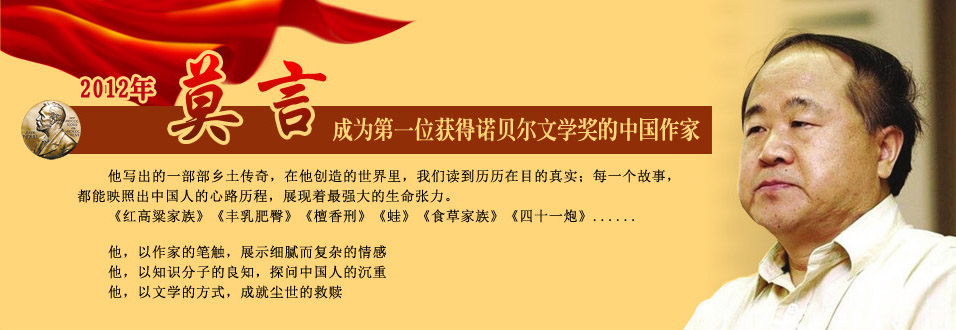
The Nobel Prize in Literature 2012 Award Ceremony Speech
诺贝尔文学奖2012年颁奖典礼给莫言的授奖词(钟宜霖译本)
尊敬的国王和王后陛下,尊敬的诺贝尔获奖者,女士们,先生们,
莫言是一个诗人,他撕破了程式化的宣传海报,让个人从无名的大众群体中凸现出来。莫言以嘲讽的手法****历史和它的谎言、被它剥夺的和政治的虚伪假象。他以戏谑和毫无掩饰的快乐手法揭露着人类生存现状中最黑暗丑陋的部分,并且几乎是在无意中找到了最沉重而强有力的象征性的画面。
高密东北乡体现了中国的民间传说和历史。很少有真正的旅行能够超越它们,进入到这个驴和猪的叫喊声淹没了人民委员的声音、爱与邪恶同时呈现出超自然比例的世界中。
莫言的想象超越了整个人类的生存现状。他是一个杰出的写实主义者。他熟知这里几乎所有的一切,饥饿,和20世纪中国可能从未被如此赤裸裸地描述过的残酷,以及英雄,恋人,暴徒,土匪——尤其是坚强而不屈不饶的母亲们。他给我们展示了一个真相,没有常识,甚至没有同情的世界,一个人们粗鲁、无助而又荒谬的世界。
中国历史上一再发生的吃人肉的风气就是这种悲催的证据。在莫言的小说里,吃人肉标志着极度的消费,无节制,垃圾,肉体享受和无可描述的欲望,只有他才可以试图超越一切禁忌限制地对此进行描述。在他的小说《酒国》中,最精致的美食是一个三岁的孩子。男孩成了顶级的食物,女孩反而因为被忽视而幸存。讽刺的是,由于中国的独生子女政策,被流产的女婴达到了天文数字:而因为女孩不够,她们连被吃的资格都没有。莫言曾为此写过一整部的小说:《蛙》。
莫言的故事具有神话和寓言式的伪装,他将所有的价值观都赋予在故事的主题里。(在莫言的小说里,)我们从未看到那些在毛时代的中国被塑造成典型人物的理想公民。莫言的人物们精力充沛,为实现他们的目标不择手段,甚至使用最不道德的步骤和方式,来打破他们被命运和政治所囚禁的牢笼。
和共产主义者所描绘的画报般幸福的历史不同,莫言所描述的过去,是运用夸张和戏仿的手法,从神话和民间传说中演绎出来的,比起过去五十年的宣传,这是一个更加令人信服和严酷的修订版。
在他最优秀的小说《丰乳肥臀》里,女性视角占据着主导地位,莫言用针扎般的细节描写了大跃进和1960年代的大饥荒。他嘲讽那些试图用兔子精液让绵羊受孕的伪科学革命,那些人把所有对此表示怀疑的人都打成右派。小说结尾在90年代新兴资本主义兴起时,骗子们都发财了,他们制造美容产品,并试图继续用杂交制造出凤凰。
在莫言的小说里,一个被遗忘的农民的世界生活生生而完美地出现在我们眼前,即使它最刺鼻的气味也让人感到香甜,即使是其令人震惊的冷酷无情也让人感到忘我的快感。(他的小说)没有半点枯燥的时候。这个作者对一切都了如指掌,并且把一切描绘得栩栩如生——所有的手工艺,炼铁,修房子,挖沟,放牧,还有土匪强盗的那些伎俩,他仿佛把人类一切的生活都注入到了他的笔尖。
他是继拉伯雷和威夫特之后——在我们的时代,是继加西亚*马尔克斯之后更加戏谑和震撼人心的作家。他的重口味像胡椒面一样。在他所描绘的中国过去百年的宏大图景里,既没有舞蹈的独角兽,也没有跳绳的小姑娘,但是他所描绘的猪圈里的生活的独特方式,却让人感觉我们似乎已经在那儿生活了很久很久。意识形态和各种形式的改革运动来来去去,但人类自私和贪婪的本性仍然存在。所以,莫言在所有的审判面前为众多卑微的小人物辩护者——从日本占领时期到毛时代的恐惧,一直到今天的商品狂潮。
对那些莫言家乡探险的人来说,那是一个最丰盛的美德与最卑鄙的残酷战斗着的地方,等待着他们的将会是一次最惊心动魄的文学冒险。曾有过如此史诗般的春潮席卷吞没过整个中国和世界吗?在莫言的作品里,世界文学所发出的声音淹没了其他大多数同时代人的声音。
瑞典文学院祝贺你。我请您从国王的手中接受2012年诺贝尔文学奖。
附:英文原文
The Nobel Prize in Literature 2012 Award Ceremony Speech
The Nobel Prize in Literature 2012 Award Ceremony Speech
Presentation Speech by Per Wästberg, Writer, Member of the Swedish Academy, Chairman of the Nobel Committee, 10 December 2012.
Your Majesties, Your Royal Highnesses, Esteemed Nobel Laureates, Ladies and Gentlemen,
Mo Yan is a poet who tears down stereotypical propaganda posters, elevating the individual from an anonymous human mass. Using ridicule and sarcasm Mo Yan attacks history and its falsifications as well as deprivation and political hypocrisy. Playfully and with ill-disguised delight, he reveals the murkiest aspects of human existence, almost inadvertently finding images of strong symbolic weight.
North-eastern Gaomi county embodies China's folk tales and history. Few real journeys can surpass these to a realm where the clamour of donkeys and pigs drowns out the voices of the people's commissars and where both love and evil assume supernatural proportions.
Mo Yan's imagination soars across the entire human existence. He is a wonderful portrayer of nature; he knows virtually all there is to know about hunger, and the brutality of China's 20th century has probably never been described so nakedly, with heroes, lovers, torturers, bandits – and especially, strong, indomitable mothers. He shows us a world without truth, common sense or compassion, a world where people are reckless, helpless and absurd.
Proof of this misery is the cannibalism that recurs in China's history. In Mo Yan, it stands for unrestrained consumption, excess, rubbish, carnal pleasures and the indescribable desires that only he can attempt to elucidate beyond all tabooed limitations.
In his novel Republic of Wine, the most exquisite of delicacies is a roasted three-year-old. Boys have become exclusive foodstuff. The girls, neglected, survive. The irony is directed at China's family policy, because of which female foetuses are aborted on an astronomic scale: girls aren't even good enough to eat. Mo Yan has written an entire novel, Frog, about this.
Mo Yan's stories have mythical and allegorical pretensions and turn all values on their heads. We never meet that ideal citizen who was a standard feature in Mao's China. Mo Yan's characters bubble with vitality and take even the most amoral steps and measures to fulfil their lives and burst the cages they have been confined in by fate and politics.
Instead of communism's poster-happy history, Mo Yan describes a past that, with his exaggerations, parodies and derivations from myths and folk tales, is a convincing and scathing revision of fifty years of propaganda.
In his most remarkable novel, Big Breasts and Wide Hips, where a female perspective dominates, Mo Yan describes the Great Leap Forward and the Great Famine of 1960 in stinging detail. He mocks the revolutionary pseudo-science that tried to inseminate sheep with rabbit sperm, all the while dismissing doubters as right-wing elements. The novel ends with the new capitalism of the ‘90s with fraudsters becoming rich on beauty products and trying to produce a Phoenix through cross-fertilisation.
In Mo Yan, a forgotten peasant world arises, alive and well, before our eyes, sensually scented even in its most pungent vapours, startlingly merciless but tinged by joyful selflessness. Never a dull moment. The author knows everything and can describe everything – all kinds of handicraft, smithery, construction, ditch-digging, animal husbandry, the tricks of guerrilla bands. He seems to carry all human life on the tip of his pen.
He is more hilarious and more appalling than most in the wake of Rabelais and Swift — in our time, in the wake of García Marquez. His spice blend is a peppery one. On his broad tapestry of China’s last hundred years, there are neither dancing unicorns nor skipping maidens. But he paints life in a pigsty in such a way that we feel we have been there far too long. Ideologies and reform movements may come and go but human egoism and greed remain. So Mo Yan defends small individuals against all injustices – from Japanese occupation to Maoist terror and today’s production frenzy.
For those who venture to Mo Yan's home district, where bountiful virtue battles the vilest cruelty, a staggering literary adventure awaits. Has ever such an epic spring flood engulfed China and the rest of the world? In Mo Yan's work, world literature speaks with a voice that drowns out most contemporaries.
The Swedish Academy congratulates you. I call on you to accept the 2012 Nobel Prize for Literature from the hand of His Majesty the King.
来源于:新浪博客