推荐理由
推荐理由
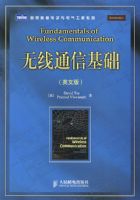
本书是一部杰出的无线通信著作。作者从一个比较高的层次、用系统的观点总结现有通信技术,并用信息论的观点诠释了近年来比较热门的MIMO、OFDM、机会通信、多用户通信等技术,着重强调概念及其在系统中的实现之间的内在联系和相互影响。深刻 的工程理解、理论远景和系统实践的完美结合,使本书不仅成为普林斯顿大学和加州大学伯克利分校等世界众多高校的教材,也被高 通等世界级通信公司用于工程师内部培训。
本书是高等院校通信和电气信息相关专业高年级本科生和研究生教材,是无线通信领域工程技术人员必备参考书。
内容简介
本书介绍无线通信的基本原理,着重强调概念及其在系统中的实现之间的相互影响,涉及的主要问题有MIMO通信、空时编码、机会通信、OFDM和CDMA等,这些概念均利用无线系统的大量实例予以说明。书中还配有大量的习题和图表,可以帮助读者进一步理解材料内容。
本书适合作为通信工程和电子信息类相关专业高年级本科生和研究生的教材,也可供工程技术人员参考。
本书作者
David Tse博士,是无线通信领域新一代权威,现任加州大学伯克利分校电气工程与计算机科学系教授,毕业于麻省理工学院。
目录
1 Introduction
1.1 Book objective
1.2 Wireless systems
1.3 Book outline
2 The wireless channel
2.1 Physical modeling for wireless channels
2.1.1 Free space, fixed transmit and receive antennas
2.1.2 Free space, moving antenna
2.1.3 Reflecting wall, fixed antenna
2.1.4 Reflecting wall, moving antenna
2.1.5 Reflection from a ground plane
2.1.6 Power decay with distance and shadowing
2.1.7 Moving antenna, multiple reflectors
2.2 Input/output model of the wireless channel
2.2.1 The wireless channel as a linear time-varying system
2.2.2 Baseband equivalent model
2.2.3 A discrete-time baseband model
Discussion 2.1 Degrees of freedom
2.2.4 Additive white noise
2.3 Time and frequency coherence
2.3.1 Doppler spread and coherence time
2.3.2 Delay spread and coherence bandwidth
2.4 Statistical channel models
2.4.1 Modeling philosophy
2.4.2 Rayleigh and Rician fading
2.4.3 Tap gain auto-correlation function
Example 2.1 Clarke’s model
Chapter 2 The main plot
2.5 Bibliographical notes
2.6 Exercises
3 Point-to-point communication: detection, diversity, and channel ncertainty
3.1 Detection in a Rayleigh fading channel
3.1.1 Non-coherent detection
3.1.2 Coherent detection
3.1.3 From BPSK to QPSK: exploiting the degrees of freedom
3.1.4 Diversity
3.2 Time diversity
3.2.1 Repetition coding
3.2.2 Beyond repetition coding
Summary 3.1 Time diversity code design criterion
Example 3.1 Time diversity in GSM
3.3 Antenna diversity
3.3.1 Receive diversity
3.3.2 Transmit diversity: space-time codes
3.3.3 MIMO: a 2×2 example
Summary 3.2 2×2 MIMO schemes
3.4 Frequency diversity
3.4.1 Basic concept
3.4.2 Single-carrier with ISI equalization
3.4.3 Direct-sequence spread-spectrum
3.4.4 Orthogonal frequency division multiplexing
Summary 3.3 Communication over frequency-selective channels
3.5 Impact of channel uncertainty
3.5.1 Non-coherent detection for DS spread-spectrum
3.5.2 Channel estimation
3.5.3 Other diversity scenarios
Chapter 3 The main plot
3.6 Bibliographical notes
4 Cellular systems: multiple access and interference management
4.1 Introduction
4.2 Narrowband cellular systems
4.2.1 Narrowband allocations: GSM system
4.2.2 Impact on network and system design
4.2.3 Impact on frequency reuse
Summary 4.1 Narrowband systems
4.3 Wideband systems: CDMA
4.3.1 CDMA uplink
4.3.2 CDMA downlink
4.3.3 System issues
Summary 4.2 CDMA
4.4 Wideband systems: OFDM
4.4.1 Allocation design principles
4.4.2 Hopping pattern
4.4.3 Signal characteristics and receiver design
4.4.4 Sectorization
Example 4.1 Flash-OFDM
Chapter 4 The main plot
4.5 Bibliographical notes
4.6 Exercises
5 Capacity of wireless channels
5.1 AWGN channel capacity
5.1.1 Repetition coding
5.1.2 Packing spheres
Discussion 5.1 Capacity-achieving AWGN channel codes
Summary 5.1 Reliable rate of communication and capacity
5.2 Resources of the AWGN channel
5.2.1 Continuous-time AWGN channel
5.2.2 Power and bandwidth
Example 5.2 Bandwidth reuse in cellular systems
5.3 Linear time-invariant Gaussian channels
5.3.1 Single input multiple output (SIMO) channel
5.3.2 Multiple input single output (MISO) channel
5.3.3 Frequency-selective channel
5.4 Capacity of fading channels
5.4.1 Slow fading channel
5.4.2 Receive diversity
5.4.3 Transmit diversity
Summary 5.2 Transmit and receive diversity
5.4.4 Time and frequency diversity
Summary 5.3 Outage for parallel channels
5.4.5 Fast fading channel
5.4.6 Transmitter side information
Example 5.3 Rate adaptation in IS-856
5.4.7 Frequency-selective fading channels
5.4.8 Summary: a shift in point of view
Chapter 5 The main plot
5.5 Bibliographical notes
5.6 Exercises
6 Multiuser capacity and opportunistic communication
6.1 Uplink AWGN channel
6.1.1 Capacity via successive interference cancellation
6.1.2 Comparison with conventional CDMA
6.1.3 Comparison with orthogonal multiple access
6.1.4 General K -user uplink capacity
6.2 Downlink AWGN channel
6.2.1 Symmetric case: two capacity-achieving schemes
6.2.2 General case: superposition coding achieves capacity
Summary 6.1 Uplink and downlink AWGN capacity
Discussion 6.1 SIC: implementation issues
6.3 Uplink fading channel
6.3.1 Slow fading channel
……
7 MIMO I: spatial multiplexing and channel modeling
8 MIMO II: capacity and multiplexing architectures
9 MIMO III: diversity–multiplexing tradeoff and universal space-time codes
10 MIMO IV: multiuser communication
Appendix A Detection and estimation in additive Gaussian noise
Appendix B Information theory from first principles
References
Index
经典书评
“Tse和Viswanath将通信技术的理论发展和实际应用完美结合在本书中。本书必将成为业界经典教材和权威参考。” ——Robert G.Galhger教授,麻省理工学院 “David Tse和Pramod Viswanath为现代无线通信撰写了一部经典著作!本书覆盖无线系统设计基础以及无线通信领域最新进展,不仅是高校通信专业理想教材,而且是无线工程领域工程技术人员的理想指南!。” ——Roberto Padovani博士,高通公司CTO