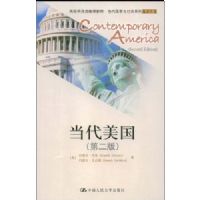
The United States of America dominates the twenty-first-century world both in military and political power as well as in its cultural influence as a model of the "good life" and a desired destination for migration. This completely revised and updated second edition of Contemporary America provides an extremely broad-ranging introduction to the society, politics,economy, culture, and world role of the United States. The authors focus on the Clinton and George W. Bush presidencies——and in particular on the period since the terrorist attacks of 9/I 1/2001 which has been marked by a growing cultural division between a largely permissive, urban Democratic "Blue" America and a largely religious, rural, and Republican "Red" America.
Illustrated throughout with relevant photographs, maps, charts, and tables,Contemporary America covers everything from rock music to national parksand from media corporations to social security. This is an ideal starting-pointin American studies for students and general readers alike.Review of the first edition:"Contemporary America has the feel of Lonely Planet meets the EconomistIntelligence Unit. It tells you all manner of things you ought to know, interspersedwith an eclectic series of digressions that act as outings to the mainjourney...Russell Duncan and Joseph Goddard write well and cover a greatdeal of ground in a text with high production values and a clear design ."Michael Foley, The Times Higher Education Supplement"[C]ogent and well balanced...All the basics anyone seeking an overview ofthe nation's major contours are here... [A]nyone reading the volume whethernew student or experienced scholar——will come away from it better informed."Dale Carter, The Newsletter of the Nordic Association for American Studies.
插图:

Today, the Midwest is prospering with the resurgence of the automobileindustry and the success of urban renewal projects to clean up and glamorizedowntown regions for tourists and patrons of the arts. The economic highs ofthe 1990s brought prosperity, better jobs, more police protection, and lowercrime rates which made the cities attractive again. Cleveland built the Rock-'n'-Roll Hall of Fame next to two new sports stadiums and a technologymuseum adjacent to where the cleaned-up Cuyahoga River flows intoLake Erie. Chicago remains central to the region as the third largest city inAmerica and center for the nation's commodities exchange. In 2001, Chicagoput on an advertising blitz, announcing its intention of becoming the nation'sgreenest and most environmentally friendly city by 2006. It is converting tosolar and wind-powered generators to supply 20 percent of the city's energyneeds, establishing bike paths, planting trees, subsidizing the installation ofenergy-efficient windows and doors, and raising fines on polluters, litterersand those who refuse to recycle (AP, 2001a).Such efforts are aimed at bringing new immigrants to the region. In 2001,for example, the state of Iowa, which is nearly 96 percent white and has thenation's third oldest citizenry the average age is 58 - began a well-funded.