内容简介
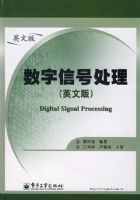
本书系统地阐述了数字信号处理所涉及的信号与系统分析和系统设计的基本理论、基本分析与设计方法、基本算法和处理技术。全书共10章,主要内容包括:离散时间信号与系统的基本概念,离散时间信号与系统的变换域分析,包括z变换和离散时间傅里叶变换、连续时间信号的抽样与重建,离散傅里叶变换及其快速算法(FFT),数字滤波器实现的基本结构,IIR和FIR 数字滤波器的设计原理与基本设计方法,数字信号处理中的有限字长效应,多抽样率数字信号处理。本书配有多媒体电子课件、英文版教学大纲、习题指导与实验手册。
本书可以作为电子与通信相关专业的本科数字信号处理课程中英文双语教学的教材,或中文授课的英文版教学参考书,也可供从事数字信号处理的工程技术人员学习参考。本书尤其适合初步开展数字信号处理课程中英文双语授课的教师与学生选用。
本书作者
蔡坤宝,博士,重庆大学通信工程学院教授,信号与信息处理硕士学位点负责人。多年来致力于随机信号的产生与处理、生物组织粘弹性波动的有限元分析、现代信号处理及其应用和人工神经网络等方面的研究工作。十余年来,积极探索和实施中英文双语教学,现任重庆市级精品课程“信号与线性系统”的负责人,并参加重庆大学精品课程“数字信号处理”的建设工作。
 目录
目录
1 Introduction
1.1 What Is a Signal?
1.2 What Is a System?
1.3 What Is Signal Processing?
1.4 Classification of Signals
1.4.1 Deterministic and Random Signals
1.4.2 Continuous-Time and Discrete-Time Signals
1.4.3 Periodic Signals and Nonperiodic Signals
1.4.4 Energy Signals and Power Signals
1.5 Overview of Digital Signal Processing
2 Discrete-Time Signals and Systems
2.1 Discrete-Time Signals: Sequences
2.1.1 Operation on Sequences
2.2 Basic Sequences
2.2.1 Some Basic Sequences
2.2.2 Periodicity of Sequences
2.2.3 Representation of Arbitrary Sequences
2.3 Discrete-Time systems
2.3.1 Classification of Discrete-Time systems
2.4 Time-Domain Representations of LTI Systems
2.4.1 The Linear Convolution Sum
2.4.2 Interconnections of LTI Systems
2.4.3 Stability Condition of LTI systems
2.4.4 Causality Condition of LTI systems
2.4.5 Causal and Anticausal Sequences
2.5 Linear Constant-Coefficient Difference Equations
2.5.1 Recursive Solution of Difference Equations
2.5.2 Classical Solution of Difference Equations
2.5.3 Zero-Input Response and Zero-State Response
2.5.4 The Impulse Response of Causal LTI Systems
2.5.5 Recursive Solution of Impulse Responses
2.5.6 Classification of LTI Discrete-Time Systems
Problems
3 Transform-Domain Analysis of Discrete-Time Signals and Systems
3.1 The z-Transform
3.1.1 Definition of the z-Transform
3.1.2 A General Shape of the Region of Convergence
3.1.3 Uniqueness of the z-Transform
3.2 Relation Between the ROCs and Sequence Types
3.3 The z-Transform of Basic Sequences
3.4 The Inverse z-Transform
3.4.1 Contour Integral Method
3.4.2 Partial Fraction Expansion Method
3.4.3 Long Division Method
3.4.4 Power Series Expansion Method
3.5 Properties of the z-Transform
3.6 The Discrete-Time Fourier Transform
3.6.1 Definition of the Discrete-Time Fourier Transform
3.6.2 Convergence Criteria
3.6.3 Properties of the Discrete-Time Fourier Transform
3.6.4 Symmetry Properties of the Discrete-Time Fourier Transform
3.7 Transform-Domain Analysis of LTI Discrete-Time Systems
3.7.1 The Frequency Response of Systems
3.7.2 The Transfer Function of LTI Systems
3.7.3 Geometric Evaluation of the Frequency Response
3.8 Sampling of Continuous-Time Signals
3.8.1 Periodic Sampling
3.8.2 Reconstruction of Bandlimited Signals
3.9 Relations of the z-Transform to the Laplace Transform
Problems
4 The Discrete Fourier,Transform
4.1 The Discrete Fourier Series
4.2 Properties of the Discrete Fourier Series
4.2.1 Evaluation of the Periodic Convolution Sum
4.3 The Discrete Fourier Transform
4.4 Properties of the Discrete Fourier Transform
4.4.1 Circular Convolution Theorems
4.5 Linear Convolutions Evaluated by the Circular Convolution
4.6 Linear Time-Invariant Systems Implemented by the DFT
4.7 Sampling and Reconstruction in the z-Domain
4.8 Fourier Analysis of Continuous-Time Signals Using the DFT
4.8.1 Fourier Analysis of Nonperiodic Continuous-Time Signals
4.8.2 Practical Considerations
4.8.3 Spectral Analysis of Sinusoidal Signals
Problems
5 Fast Fourier Transform Algorithms
5.1 Direct Computation and Efficiency Improvement of the DFT
5.2 Decimation-in-Time FFT Algorithm with Radix-2
5.2.1 Butterfly-Branch Transmittance of the Decimation-in-Time FFT
5.2.2 In-Place Computations
5.3 Decimation-in-Frequency FFT Algorithm with Radix-2
5.4 Computational Method of the Inverse FFT
Problems
6 Digital Filtor Structures
6.1 Description of the Digital Filter Structures
6.2 Basic Structures for I1R Digital Filters
6.2.1 Direct Form
6.2.2 Direct Form
6.2.3 Cascade Form
6.2.4 Parallel Form
6.3 Basic Structures for FIR Digital Filters
6.3.1 Direct Forms
6.3.2 Cascade Forms
6.3.3 Linear-Phase Forms
6.3.4 Frequency Sampling Form
Problems
7 Design Techniques of Digital IIR Filters
7.1 Preliminary Considerations
7.1.1 Frequency Response of Digital Filters
7.2 Discrete-Time Systems Characterized by Phase Properties
7.3 Allpass Systems
7.3.1 Nonminimum-Phase Systems Represented by a Cascade Connection
7.3.2 Group Delay of the Minimum-Phase Systems
7.3.3 Energy Delay of the Minimum-Phase Systems
7.4 Analog-to-Digital Filter Transformations
7.4.1 Impulse Invariance Transformation
7.4.2 Step Invariance Transformation
7.4.3 Bilinear Transformation
7.5 Design of Analog Prototype Filters
7.5.1 Analog Butterworth Lowpass Filters
7.5.2 Analog Chebyshev Lowpass Filters
7.6 Design of Lowpass IIR Digital Filters
7.6.1 Design of Lowpass Digital Filters Using the Impulse Invariance
7.6.2 Design of Lowpass Digital Filters Using the Bilinear Transformation
7.7 Design of IIR Digital Filters Using Analog Frequency Transformations
7.7.1 Design of Bandpass IIR Digital Filters
7.7.2 Design of Bandstop I]R Digital Filters
7.7.3 Design of Highpass IIR Digital Filters
7.8 Design of IIR Digital Filters Using Digital Frequency Transformations
7.8.1 Lowpass-to-Lowpass Transformation
7.8.2 Lowpass-to-Highpass Transformation
7.8.3 Lowpass-to-Bandpass Transformation
7.8.4 Lowpass-to-Bandstop Transformation
Problems
8 Design of FIR Digital Filters
8.1 Properties of Linear Phase FIR Filters
8.1.1 The Impulse Response of Linear-Phase FIR Filters
8.1.2 The Frequency Response of Linear-Phase FIR Filters
8.1.3 Characteristics of Amplitude Functions
8.1.4 Constraints on Zero Locations
8.2 Design of Linear-Phase FIR Filters Using Windows
8.2.1 Basic Techniques
8.2.2 Window Functions
8.2.3 Design of Linear-Phase FIR Lowpass Filters Using Windows
8.2.4 Design of Linear-Phase FIR Bandpass Filters Using Windows
8.2.5 Design of Linear-Phase FIR Highpass Filters Using Windows
8.2.6 Design of Linear-Phase FIR Bandstop Filters Using Windows
Problems
9 Finite-Wordlength Effects in Digital Signal Processing
9.1 Binary Number Representation with its Quantization Errors
9.1.1 Fixed-Point Binary Representation of Numbers
9.1.2 Floating-Point Representation
9.1.3 Errors from Truncation and Rounding v
9.1.4 Statistical Model of the Quantization Errors
9.2 Analysis of the Quantization Errors in A/D Conversion
9.2.1 Statistical Model of the Quantization Errors
9.2.2 Transmission of the Quantization Noise through LTI Systems
9.3 Coefficient Quantization Effects in Digital Filters
9.3.1 Coefficient Quantization Effects in IIR Digital Filters
9.3.2 Statistical Analysis of Coefficient Quantization Effects
9.3.3 Coefficient Quantization Effects in FIR Filters
9.4 Round-off Effects in Digital Filters
9.4.1 Round-off Effects in Fixed-Point Realizations of ILR Filters
9.4.2 Dynamic Range Scaling in Fixed-Point Implementations of IIR Filters
9.5 Limit-Cycle Oscillations in Realizations of IIR Digital Filters
9.5.1 Zero-Input Limit Cycle Oscillations
9.5.2 Limit Cycles Due to Overflow
9.6 Round-off Errors in FFT Algorithms
9.6.1 Round-off Errors in the Direct DFT Computation
9.6.2 Round-off Errors in Fixed-point FFT Realization
Problems
10 Multirate Digital Signal Processing
10.1 Sampling Rate Changed by an Integer Factor
10.1.1 Downsampling with an Integer Factor M
10.1.2 Decimation by an Integer Factor M
10.1.3 Upsampling with an Integer Factor L
10.1.4 Interpolation by an Integer Factor L
10.2 Sampling Rate Conversion by a Rational Factor
10.3 Efficient Structures for Sampling Rate Conversion
10.3.1 Equivalent Cascade Structures
10.3.2 Polyphase Decompositions
10.3.3 Polyphase Realization of Decimation Filters
10.3.4 Polyphase Realization of Interpolation Filters
Problems
Appendix A Tables for the z-Transform
Appendix B Table for Properties of the Discrete-Time Fourier Transform
Appendix C Table for Properties of the Discrete Fourier Series
Appendix D Table for Properties of the Discrete Fourier Transform
Appendix E Table for the Normalized Butterworth Lowpass Filters
Appendix F Answers To Partial Problems
References