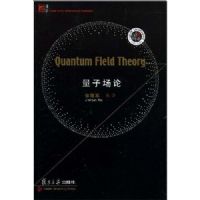
Quantum field theory has been an elementmp course for the students majored in theoretical physics. In recent years it has become a basic knowledge needed for all the students in physics.
徐建军,1959年8月生于上海。1982年春毕业于复旦大学物理系,1989年l月获得博士学位。从 1984年开始,在复旦大学物理系任教至今。现为复旦大学物理系副教授。已发表学术论文20余篇,出版著作《超对称物理导论》、《数学物理方法解题指导》、《电动力学》(第二版),出版译著《不论》。主要从事理论物理方面课程的教学和研究工作,开设过电动力学、高等数学、数学物理方法、应用数学、量子场论、群论、天体物理概论等本科生和研究生课程。
PREFACE
Notations and Conventions
Chapter 1The Klein-Gordon Field
1.1Introduction
1.2The Klein-Gordon Equation
1.3Elements of Classical Field Theory
1.3.1Lagrangian Field Theory
1.3.2Hamiltonian Field Theory
1.3.3Noether's Theorem
1.4The Canonical Quantization of the Scalar Field
1.5The Klein-Gordon Field in Space-Time
1.5.1Causality
1.5.2The Klein-Gordon Propagator
Chapter 2The Dirac Field
2.1The Dirac Equation
2.1.1The Dirac Equation
2.1.2Weyl Spinor
2.2Free-Particle Solutions of the Dirac Equation
2.2.1Plane-Wave Solution
2.2.2Spin Sum
2.3Dirac Matrices and Dirac Field Bilinears
2.4Quantization of the Dirac Field
2.4.1Canonical Quantization of the Dirac Field
2.4.2The Dirac Propagator
2.5Discrete Symmetries of the Dirac Theory(CPT)
2.5.1Parity
2.5.2Time Reversal
2.5.3Charge Conjugation
Chapter 3 The Electromagnetic Field
3.1The Maxwell Equations
3.2Local Gauge Symmetry
3.3Quantization of the Electromagnetic Field in
Coulomb Gauge
3.4Quantization of the Electromagnetic Field in
Covariant Gauge
Chapter 4Perturbation Theory
4.1Perturbation Theory
4.2S-Matrix
4.2.1Time-Evolution Operator
4.2.2S-Matrix
4.3Wick Theorem
4.4Feynman Diagrams (44 Theory)
4.5Feynman Rules for Quantum Electrodynamics
4.5.1The First-order Process
4.5.2The Second-order Process
4.5.3Various Physical Processes
4.5.4Self-Energy
4.6Feynman Rules in Momentum Space
4.6.1Feynman Diagrams in Momentum Space
4.6.2Compton Scattering in Momentum Space
4.6.3Feynman Rules in Momentum Space
Chapter 5Elementary Processes of Quantum
Electrodynamics
5.1The Cross Section
5.2Sum of Polarization States
5.2.1Spin Sum
5.2.2Polarization Sum
5.3e - e + --~/.t -/x + Process
5.4Bhahha Scattering
5.5Compton Scattering
5.6Scattering by an External Field
Chapter 6Radiative Corrections
6.1Radiative Corrections
6.2Regnlarization
6.3Renormalization
Chapter 7Functional Method
7.1Path Integrals in Quantum Mechanics
7.2Functional Quantization of the Scalar Fields
7.3Functional Quantization of the Electromagnetic Fields...
7.4Functional Quantization of the Spinor Fields
References
Index
……
Quantum field theory has been an elementmp course for the students majored in theoretical physics. In recent years it has become a basic knowledge needed for all the students in physics. There is much more variation in style and content among quantum field theory courses
than, for example, quantum mechanics. Quantum field theory is indeed a hard course. But we knew that physics was a hard major Quantum field theory is still an active research topic, even though it has had many experimentally confirmed results since l940's. As a result, a quantum field theory course has the flavor of research f there is no set of mathematically rigorous rules to solve any problem.
Answers are not final, and should be treated as questions. One should not be satisfied with the solution of a problem, but consider it as a first step toward generalization.
This book arose from the lecture given to the graduate students in Physics Department of Fudan University since l994. The contents of the book are arranged as follows. The first three chapters deal with the basic properties and the quantization of the free scalar, spinor and electromagnetic fields, respectively. Chapter 4 transits to the perturbation theory and chapter 5 is a brief introduction of the quantum electromagnetic processes. Chapter 6 represents the
radiative corrections and finally, chapter 7 introduces the functional method used in quantum field theory. This textbook is designed for the graduates in Physics, but it also be of interest to scientists and engineeers major in sub--atomic fields.