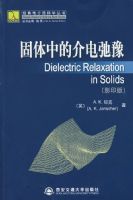
推荐理由本书是琼斯克教授于1983年出版的提出固体中的介电弛豫理论的经典专著,在国际学术界享有盛誉,并被电介质领域的许多研究者奉为经典。书中介绍了介质极化的基础知识和介电函数的表述方法,在此基础上讨论了几种理想化模型的的动态响应特征,结合频域响应和时域响应的多种实验现象,总结提出了介电弛豫的多体普适模型。其内容包括:引言,电介质极化的数理基础,理想物理模型的动力响应,频率响应的实验证据,时间响应的实验证据,已得到公认的解释,介电弛豫的多体普适模型。
 内容简介
内容简介
本书是研究固体中介电弛豫现象的专著,被电介质领域的许多研究者奉为经典。作者提出在所有固体介质中存在普适的分数指数弛豫定律,其观点在学术界经历了从不被理解到广泛接受的曲折过程。书中介绍了介质极化的基础知识和介电函数的表述方法,在此基础上讨论了几种理想化模型的的动态响应特征,结合频域响应和时域响应的多种实验现象,总结提出了介电弛豫的多体普适模型。
全书行文流畅、简明扼要,可作为物理、电子、材料、电气等相关专业的教师、研究生和科研人员的参考书。精读此书有助于深入、全面地理解电介质、半导体、电池及其他电子元器件测量中的实验结果。
本书作者
A.K.琼克,(A.K.Jonscher,1922—2005),生于波兰华沙,1949年在伦敦大学玛丽皇后学院以一级荣誉学士学位毕业,并在该校Harry Tropper教授的指导下于1952年获得博士学位,1951年起在GEC研究实验室工作,从事半导体器件物理原理方面的研究工作,1962年以Reader身份加入伦敦大学切尔西学院,1965年成为固态电子学教授,1987年成为伦敦大学皇家霍洛威与贝德福德斯学完荣誉教授,1990年受邀担纲IEEE“普适介电响应”杰出怀特海荣誉讲席。琼克教授在介电弛豫研究方面具有很深的造诣,他于1983年和1996年分别出版的学术专著《固体中的介电弛豫》和《普适弛豫定律》,在国际学术界享有盛誉。
目录
Preface
Useful Physical Constants
Chapter 1
INTRODUCTION
1.1 Dielectrics and insulators
1.2 The nature of dielectric response
1.3 The purpose and scope of the present treatment
References to Chapter 1
Chapter 2 THE PHYSICAL AND MATHEMATICAL BASIS OF DIELECTRIC POLARISATION
2.1 Charges, dipoles and chemical bonds
2.2 Dielectric polarisation
2.3 Polarisation in static electric fields
a) Orientational polarisation - freely floating dipoles
b) Molecular polarisability - induced dipole moment
c) Orders of magnitude of dipole moments and polarisabilities
d) Polarisation by hopping charge carriers
2.4 Effect of particle interactions
2.5 Time-dependent dielectric response
2.6 Frequency-domain response
2.7 Permittivity, conductivity and loss
2.8 Kramers-Kronig relations
Appendix 2.1 Fourier transform of the convolution integral
Appendix 2.2 Computer programs for Kramers-Kronig transformation C--* G and G--* C
References to Chapter 2
Chapter 3 PRESENTATION OF DIELECTRIC FUNCTIONS
3.1 Introduction
3.2 Admittance, impedance, permittivity
3.3 More complicated equivalent circuits
i) Series R-C in parallel with C~
ii) Resistance in series with parallel G--C combination
iii) Capacitance in series with parallel G--C combination
iv) Two parallel circuits in series
v) Distributed R-C line
3.4 Summary of simple circuit responses
3.5 Logarithmic impedance and admittance plots
3.6 The response of a "universal" capacitor
3.7 Representation in the complex permittivity plane
3.8 Representation of the temperature dependence
Appendix 3.1 Time domain, rotating vectors and frequency domain
Appendix 3.2 Inversion in the complex plane
References to Chapter 3
Chapter 4 THE DYNAMIC RESPONSE OF IDEALISED PHYSICAL MODELS
4.1 Introduction
4.2 The harmonic oscillator
4.3 An inertialess system with a restoring force
ii) Schottky barriers and p-n junctions
iii) Charge generation~recombination processes
iv) Trapping phenomena
4.8 Diffusive transport
4.9 Concluding comments
Appendix 4.1 The complex susceptibility of an inertialess system with a restoring force
Appendix 4.2 Relaxation of "free" charge
References to Chapter 4
Chapter 5 EXPERIMENTAL EVIDENCE ON THE FREQUENCYR ESPONSE
5.1 Introduction
5.2 Near-Debye responses
5.3 Broadened and asymmetric dipolar loss peaks
a) Polymeric materials
b) Other dipolar systems
c) Dipolar response at cryogenic temperatures
d) Characterisation of dielectric loss peaks
5.4 Dielectric behaviour of p-n junctions
5.5 Dielectric response without loss peaks
a) Charge carriers in dielectric materials
b) Alternating current conductivity of hopping charges
c) Fast ionic conductors
5.6 Strong low-frequency dispersion
5.7 Frequency-independent loss
5.8 Superposition of different mechanisms
5.9 Survey of frequency response information
References to Chapter 5
Chapter 6 EXPERIMENTAL EVIDENCE ON THE TIME RESPONSE
6.1 The role of time-domain measurements
6.2 The significance of loss peaks in the time--domain
6.3 The Hamon approximation
6.4 Evidence for inertial effects
6.5 Long-time behaviour in low-loss polymers
6.6 Detection on non-linearities by time--domain measurements
6.7 Contribution of charge carriers to the dielectric response
6.8 Other charge carrier phenomena
a) Charge injection and surface potential
b) Energy loss arising from the movement of charges
c) Dispersive charge flow
d) Charge carrier systems with strong dispersion
6.9 Conclusions regarding time--domain evidence
a) The presence to two power laws
b) The temperature dependence of the universal law
c) Limiting forms of response at "zero" and "infinite" times
d) The Debye "singularity"
e) Time--dom
7.2 Distributions of relaxation times (DRT's)
7.3 Distributions of hopping probabilities
7.4 Correlation function approaches
7.5 Local field theories
7.6 Diffusive boundary conditions
7.7 Interracial phenomena and the Maxwell-Wagner effect
7.8 Transport limitation at the boundaries
7.9 The need for an alternative approach
References to Chapter 7
Chapter 8 THE MANY-BODY UNIVERSAL MODEL OF DIELECTRIC RELAXATION
8.1 The conditions for the occurrence of the universal response
8.2 A descriptive approach to many-body interaction
a) The screened hopping model
b) The role of disorder in the dielectric response
c) The correlated states
d) "Large" and "small" transitions
8.3 The infra-red divergence model
a) The inapplicability of exponential relaxation in time
b) Physical concepts in infra-red divergence
c) The Dissado-Hill model of "large" and "small" transitions
d) The small flip transitions
e) Fluctuations or flip-flop transitions
f) The complete analytical development of relaxation
8.4 The consequences of the Dissado-Hill theory
a) The significance of the loss peak
b) The temperature dependence of the loss peak
c) Dipole alignment transitions
d) The exponents m and n
e) The temperature dependence of the "flat" loss
f) The narrow range of ac conductivities
8.5 Clustering and strong low-frequency dispersion
8.6 Energy relations in the many-body theory
a) Stored energy in the static and transient regimes
b) Transfer of energy to the heat bath
c) Dielectric and mechanical loss
8.7 The dynamics of trapping and recombination in semiconductors
8.8 Dielectric diagnostics of materials
8.9 Conclusions
Appendix 8.1 The infra-red divergence
References to Chapter 8
Author Index
Subject index
书摘与插图