内容简介
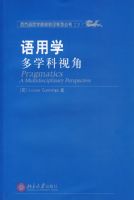
《语用学:多学科视角》的作者Louise Cummings博士现在诺士汉特伦特大学从事语言学研究与教学。她的研究范围包括语用学、语言与心智哲学、语言病理学、论辨与推理谬论等。至今已在Argumentation,Metaphiosophy,Informal Logic,Journal of Pragmatics等国际期刊上发表多篇论文,其研究的一个最大特点就是多学科性。比如,她正在从事的一研究课题“会话失败:语用混乱的作用”就涉及(言语)交际学、病理学、语言学尤其是语用学等学科之间的交叉。此外,她的另一本新作《临床语言学:理论与实践》也体现了Louise Cummings的多学科研究视角。
本书的主要特点:第一,多学科性与多视角性。通过全书各种语用学理论的阐释与分析,作者的最终目的在于说明,任何一门学科都不可能仅以自身为基础提出一种可靠的语用语理论。这一观点已在本书多处地方显露。然而,作者也认为,语用学理论所关注的多学科性应该不同于哲学、心理学、人工智能、语言病理学等所涉及的多学科性。
第二,批辩性与反思性。作者在介绍语用学的重要概念与理论的同时,对它们的不足与不合理性进行了批评与自我辩论,意在从更新的角度去再现语用学的现状,并展现其未来,这是本书的重要贡献与价值。
 目录
目录
List of Figures and Tables
Acknowledgements
Preface
1 The Multidisciplinary Nature of Pragmatics
1.1 Pragmatics and its Academic Neighbours
1.2 Pragmatics: A Standard Definition
1.2.1 Information
1.2.2 Encoding
1.2.3 Convention
1.2.4 Context
1.2.5 Use
1.3 Pragmatic Concepts and Theories
1.3.1 Speech act theory
1.3.2 Implicature theory
1.3.3 Relevance theory
1.3.4 Deixis
1.3.4.1 Person and social deixis
1.3.4.2 Time deixis
1.3.4.3 Place deixis
1.3.4.4 Discourse deixis
1.3.5 Presupposition
Notes
2 Theories of Meaning
2.1 Approaches to the Study of Meaning
2.2 Meaning: A Three-part Approach
2.3 A Referential Approach to Meaning
2.3.1 Philosophical foundations: Tarski and Davidson
2.3.2 Truth-conditional semantics
2.3.3 Referential meaning and other disciplines
2.4 A Psychologistic Approach to Meaning
2.4.1 The necessity of psychologistic meaning:Chomsky and Fodor
2.4.2 Pragmatics, the language of thought and related notions
2.4.3 Other disciplines, the language of thoughtand related notions
2.5 A Social Approach to Meaning
2.5.1 Discourse analysis and conversation analysis
Notes
3 Inferences
3.1 Pragmatics and Inference
3.2 Deductive Inferences
3.2.1 Three types of syllogism
3.2.2 Deductive inferences and semantic meaning
3.2.3 Deduction, reasoning and utterance interpretation
3.3 Elaborative Inferences
3.3.1 The psychology of elaborative inferences
3.3.2 Elaborative inferences, knowledge and AI
3.3.3 Elaborative inferences and pragmatics
3.4 Conversational Inferences
3.4.1 Grice on deriving implicatures
3.4.2 Recovering implicatures: The views of other theorists
3.4.3 Psychology and conversational inferences
Notes
4 Relevance Theory
4.1 Overview
4.2 Relevance and Communication
4.3 Relevance and Cognition
4.4 A Philosophical Criticism of Relevance Theory
4.4.1 Logical positivism: Some background
4.4.2 Putnam on positivism
4.4.3 The scientific reductionism of relevance theory
4.4.3.1 Challenging reductionism I: Elimination rules
4.4.3.2 Challenging reductionism 2:Deduction and comprehension
4.4.3.3 Challenging reductionism 3:Functional confirmation
4.5 Conclusion
Notes
5 Pragmatics and Mind
5.1 The Need for a Pragmatic Study of Mind
5.2 Language and Mind: Some Historical Antecedents
5.3 The Modularity of Mind Thesis
5.3.1 Representation
5.3.2 Computation
5.3.3 Organisation
5.4 Pragmatics and Modularity
5.4.1 Kasher on the modularity of pragmatics
5.4.1.1 Pragmatic module
5.4.1.2 Pragmatic central system
5.4.1.3 Pragmatic interface
5.4.2 Wilson and Sperber on the modularity of pragmatics
5.5 If not Modularity, then What?
Notes
6 Argumentation and Fallacies of Reasoning
6.1 Pragmatics and Argument
6.2 What Is an Argument? A Fallacy?
6.3 Six Theoretical Frameworks
6.4 A Pragmatic Turn in the Study of Argument
6.5 Pragma-Dialectics:An Advance in the Study of Argumentation?
6.6 Methodology: Reconstruction and Evaluation
6.6.1 Reconstruction
6.6.2 Evaluation
Notes
7 Habermas and Pragmatics
7.1 Why Study Habermas?
7.2 Expanding Reason: Habermas on Positivism
7.3 Habermas on Language
7.4 Criticising Habermas: A Putnamian Challenge
7.5 Conclusion
Notes
8 Artificial Intelligenee and Pragmatics
8.1 Why Study Artificial Intelligence?
8.2 Pragmatics: Implications for AI
8.3 AI on Pragmatics
8.3.1 Syntactic and semantic representations
8.3.2 Knowledge representation
8.3.3 Reasoning
8.3.4 Rationality principles
8.4 Is AI possible?
Notes
9 Language Pathology and Pragmatics
9.1 When Pragmatics Goes Wrong
9.2 Problems of Definition
9.2.1 Speech acts
9.2.2 Context
9.2.3 Listener knowledge
9.2.4 Conversational maxims and implicature
9.2.5 Inferences
9.2.6 Knowledge
9.2.7 Non-literal meaning
9.2.8 Deixis
9.2.9 Conversation analysis and discourse analysis
9.3 Pragmatic Disorders
9.3.1 Developmental language disorder
9.3.2 Autism
9.3.3 Learning disability
9.3.4 Left-hemisphere damage
9.3.5 Right-hemispkere damage
9.3.6 Closed-head injury
9.3.7 Alzheimer's disease
9.3.8 Schizophrenia
9.4 What Can We Learn from Pragmatic Disorders?
Notes
10 Beyond Disciplines
10.1 Multidisciplinary Pragmatics
10.2 The Relationship of Other Disciplines to Pragmatics
10.2.1 Philosophy
10.2.2 Psychology
10.2.3 Artificial intelligence
10.2.4 Language pathology
10.3 The Relationship of Pragmatics to Other Disciplines
10.4 New Topics and Disciplines
Notes
Bibliography
Index